

Bacic’s paintings investigate the evolving language of abstraction through an interplay of gesture, geometry and figuration. Employing vibrant fields of colour alongside fractured linear structures, her
work generates dynamic tensions between illusion and materiality. Situated within the historical and perceptual conditions of abstract painting, Bacic’s practice foregrounds the medium’s inherent contradictions- where surface and depth, reality and illusion, remain in continual negotiation.
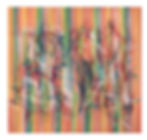
Her process unfolds through a deliberate sequence of translations that function as both method and conceptual framework. Each work begins with a film photographs, she establishes an initial representational structure anchored in reality. These photographs are translated into small gouache sketches, where contours soften, colour fields shift, and the image begins its first transformation away from representation. When brought onto canvas, the image undergoes a further transformation: stripes are introduced, cutting across the composition and interrupting its coherence. These strips alternately obscure and reveal, disrupting recognisable imagery while asserting the painting’s material presence. Through this process, translation becomes a means of resisting fixity, allowing the painting to be continually reconfigured rather than resolved.
As the image passes through successive stages– from reality to photograph, sketch, canvas, and stripes - the trajectory of the mark becomes visible. Lines, bands, and gestures emerge through displacement, repetition, and modulation. Dense zones give way to sparse passages; marks appear, dissolve, and reassert themselves. Across the canvas, gradients of presence and erasure unfold, transforming the pictorial field into an environment of forces rather than a container of stable forms. In this context, the mark is not merely a visual element but an unfolding event: an active agent shaped friction, pressure, light and time.
Through these operations, Bacic’s paintings question inherited pictorial models and the forms of visual authority they produce. Rather than resolving contradiction, the works activate it, staging sustained tensions between illusion and reality, image and object, structure, and collapse. Refusing fixed readings, they produce a shifting perceptual field in which meaning arises through friction, ambiguity, and continual recalibration. In doing so, Bacic asserts abstraction as a critical language – one that resists closure and remains open to complexity, contingency and sustained looking.
Installation views from exhibitions between 2024 - now